
When I asked if there were any volunteers to help me return all my supplies to the art closet every hand went up. I loaded three of them up and we lugged all the stuff back to the library. As we walked one of the boys said, in the most heartfelt way, “I have a question. And maybe it’s mean, but I don’t think it’s mean…” to which I encouraged him to ask away. He told me he overheard some kids talking about Lucy going blind and that he noticed her eye shaking and he wondered what was happening to her.
I looked into his eyes and told him that was really a wonderful question and that I should probably come to the classroom and talk about exactly what’s happening with Lucy.
He looked right back at me and said, “can you do it right now?”
It was seriously the sweetest thing. I’ve always thought it would be a good thing to go explain things in detail to the kids (a friend did that with her child years ago…totally different issues, but it was a really positive thing). Her Braille teacher and I discussed it earlier in the year and we weren’t sure if Lucy was quite ready for that. We weren’t sure if her class was ready either.
But that afternoon as that sweet boy asked me those questions I realized the class was ready. And when I mentioned the idea to Lucy after school I realized she was ready too. A big huge smile crept across her face and she was so excited for me to figure out a time to come in.
So I did.
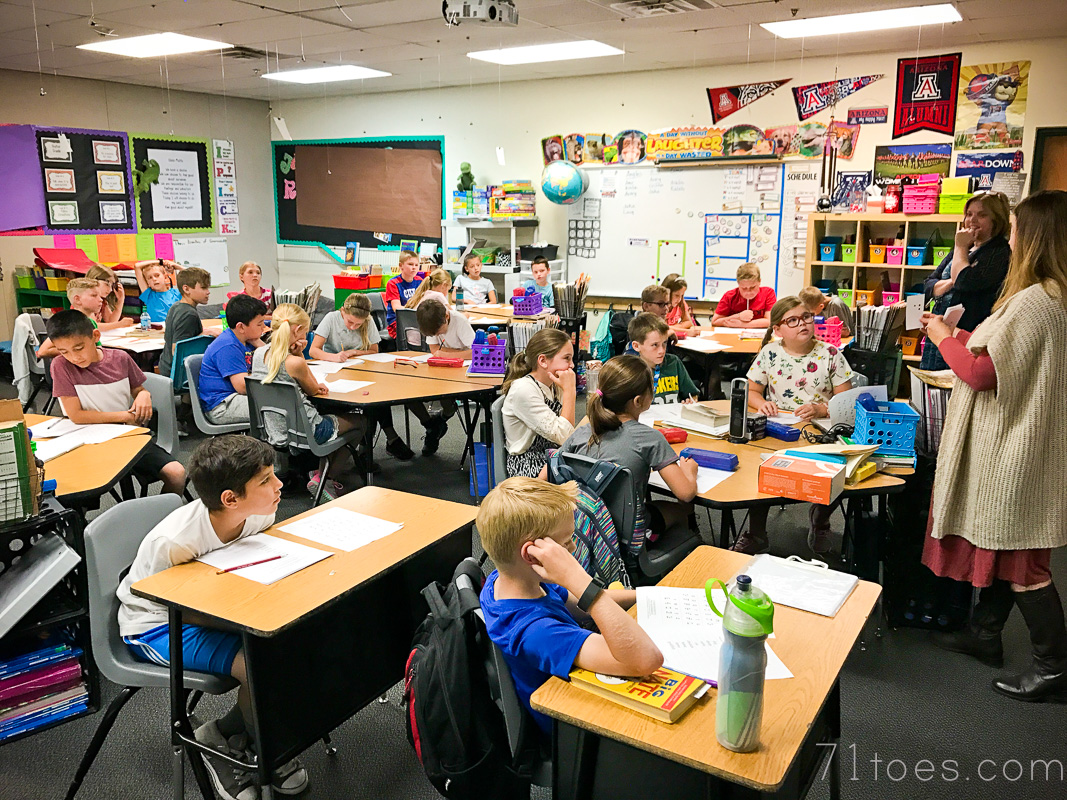
I coordinated with the Braille teacher and we both went in on Tuesday this week to tell all about BBS and what’s happening in Lucy’s world.
I started by explaining that we all have things that are good in life, and we also all have things that are tough. We talked about how Lucy wants to be an author and showed them the book she’s writing and talked about all the things she’s good at. Then we talked about the things that are tough for her, and told them all about what Bardet-Biedl is. The Braille teacher gave out worksheets for the kids to figure out their own names in Braille and they were mesmerized. Lucy got to show off her skills at reading Braille. There were jaw drops of amazement among the kids 🙂 They had all kinds of great questions like how do syndromes happen and why do we raise money and how do scientists figure out how to help and one mentioned she has a cousin who already uses a white cane and the Braille teacher talked about why Lucy has a different computer than the rest of them, and uses a different keypad (she can’t see the curser very well on regular computers and needs keyboards with better contrast…tough to see gray on white). She explained contrast and how Lucy doesn’t see it and Lucy helped a little to explain to the kids how she sees the world.
It was a good talk. I hope these kids will continue to ask questions and learn and grow, because knowledge is power. Hopefully we gave them all, including Lucy, a little extra power that afternoon.
This is wonderful! It makes my heart so happy that those dear students could be informed about sweet Lucy and those tough things from some great sources. Whether they realized it or not, I'm sure that this planted a seed of compassion in their hearts.
This is such goodness! Lucy is already changing the world for the better.
So good. All around so good. Good for asking questions. Good for receiving questions well. Good for answering all the questions in such a thoughtful (and thought-provoking way). I don't know why this post impacted me so, but my heart is soaring with all the good surrounding it! You're teaching our next generation to have compassion. Lucy is my hero!
Lots of tears flowing for the good, kind kids in this world. What a wonderful experience.
What a wonderful experience and opportunity for all. Thank you for sharing this today. -Lisa
This is so emotional & choked me up.
It's lovely that Lucy etc has been able to explain to the children in her class about what she is going through.
Happy Easter by the way. X
I absolutely love this. Kids are so thoughtful and curious about their world. I'm glad that it was the right time and there was interest. What a wonderful way to help a child fit in by showcasing something special about them to promote understanding and compassion.
This made me emotional. Kids can be so great and thoughtful and want to learn. I'm so glad you were able to go and teach them wth Lucy
This brought tears to my eyes. Sad for the struggles Lucy faces but happy tears for the wonderful mom and teachers and kids and community rallying around her to support it.
Wow what a sweet brave boy to inquire! God sends little messengers and I'm glad he promted the Lucy discussion xoxo
I love this! When my daughter was in first grade (she's now 16), her teacher talked to the kids in that class about autism and how it affects friends they know and love (this teacher had two of her own children with autism). At the time, I loved her proactiveness and efforts to educate those children at a very impressionable time about something so important. With the hindsight of 10 years, I am only more impressed by her wisdom. My daughter has always been very accepting, loving, and unafraid of her peers (and others) who carry that challenge. Knowledge and education are powerful. Kudos to you for being positive and promoting compassion!
I am so thankful it was a positive experience for you and Lucy.
Beautiful ❤
This is beautiful. I was a part of a program in my elementary school where they would put the top students in the grade in the same class with students who needed a little extra help. My
class would have two teachers. One who was the main teacher and one to pull kids aside when they needed extra help. My parents said they could see a change in me the first week in my class. My understanding of compassion
grew and it created a desire to show kindness to everybody regardless of who they were.
I think explain and showing kids how everyone has different challenges but that they are still just people is the key to an inclusive and accepting society. So glad you were able to do that.
This is just so awesome! It was so helpful to everyone in the class but especially to Lucy! In Finland they have a class for school kids called "Empathy!"I What a spectacular idea to teach kids how to empathize with others' situations! There would be so much less bullying if there could be a teacher teaching things like you and this wonderful Braille teacher did…every day! I am so happy to read this, even though I'm crying! Love you!
I'm crying!!! I've called you a couple years ago about my other daughter who we thought had BBS which she ended up with a different syndrome (pallister-hall) but now my other daughter is blind 🙂 I know I need to call you at some point because you're the only person I know in the Arizona world who's child is in elementary school and I need help wth IEPs and Braille teachers And school in general! Do you do anything with the Foundation for Blind children?? So I'll probably be giving you a ring at some point 🙂 thank you for sharing this story! It gives me so much hope that kids will be kinda and genuine in their curiosity!
knowledge helps fight discrimination, so it's great the kids asked to know about Lucy. so brave of her